In 2026, artificial intelligence (AI) is becoming an increasingly important part of supply chain management. As logistics networks face fluctuating demand, tighter delivery windows, rising transportation costs, and persistent labor shortages, traditional Transportation Management Systems (TMS) and manual dispatch processes are facing growing operational challenges.
Enterprise logistics leaders are moving beyond standalone technology solutions toward integrated platforms that connect planning, execution, and visibility
The four layers of the Enterprise AI Logistics Stack include:
Predictive Demand Forecasting: Anticipating shipment volumes, resource requirements, and changing demand patterns.
Dynamic Route & Resource Optimization: Optimizing delivery routes, vehicle capacity, driver allocation, and transportation resources.
Real-Time Network Visibility & Exception Management: Tracking shipments, identifying disruptions, and enabling timely corrective action.
Autonomous Execution & Workflow Automation: Automating dispatch, operational workflows, and routine decisions based on business rules and real-time conditions.
Together, these capabilities connect demand planning with transportation execution, helping enterprises respond to changing conditions and coordinate complex delivery operations.
This blog explores how each layer works, how the capabilities integrate to support operational resilience, and how enterprise delivery orchestration
Predictive demand forecasting is the foundation of an AI-driven logistics strategy. It helps enterprises anticipate future shipment volumes, understand changing demand patterns, and align inventory and transportation capacity with expected delivery requirements.
Traditional supply chain forecasting often relies on historical averages, such as weekly shipment volumes across regional distribution hubs. While this approach supports high-level budgeting and planning, it may not provide the operational detail required to manage last-mile delivery
AI-powered demand forecasting enables organizations to move beyond historical averages toward more granular, data-driven planning.
Modern AI logistics systems can analyze demand at a more granular level, including individual stock-keeping units (SKUs), delivery locations, and specific time windows.
By combining internal and external data sources, machine learning models can identify demand patterns and generate forecasts based on multiple influencing factors, including:
Historical order volumes and purchasing patterns.
Point-of-sale (POS) data and changes in customer demand.
Promotional campaigns, seasonal trends, and scheduled events.
Local events, weather conditions, and regional demand fluctuations.
These insights help businesses estimate what products customers may order, where demand is likely to occur, and when shipments may need to be fulfilled.
For enterprises managing large distribution networks, this level of forecasting can support more precise inventory planning and transportation decisions.
Accurate demand forecasting helps enterprise shippers retailers
By anticipating shipment volumes and regional demand, organizations can align inventory, vehicles, drivers, and delivery schedules with expected operational requirements.
1. Strategic Inventory Pre-Positioning
Businesses can position inventory closer to areas with high or anticipated demand. This reduces unnecessary transportation distances, supports faster fulfillment, and helps improve last-mile delivery
2. Advance Fleet and Driver Planning
Forecasted shipment volumes help logistics teams plan vehicle capacity, driver schedules, and transportation resources days in advance. This can reduce dependence on costly last-minute third-party carrier
3. Managing the Bullwhip Effect
In multi-echelon distribution networks, small changes in customer demand can create larger fluctuations in inventory and replenishment requirements upstream. Better demand visibility
When integrated with transportation planning and execution systems, predictive demand forecasting helps enterprises connect anticipated demand with actionable logistics decisions.
This enables organizations to improve capacity planning, prepare for demand fluctuations, and coordinate distribution resources across complex supply chains.
However, forecasting alone cannot ensure timely deliveries. Its value increases when forecast insights feed directly into route optimization
Demand forecasting helps logistics teams anticipate what needs to be delivered. The next challenge is determining how, when, and with which resources those deliveries should be executed.
Traditional route planning
AI-powered route optimization addresses this challenge by continuously evaluating changing operational conditions and adjusting transportation plans accordingly.
Modern AI route optimization
Depending on the logistics environment, the system can incorporate data such as:
Live vehicle GPS and telemetry data
Current and predicted traffic conditions
Weather alerts and road conditions
New or modified delivery orders
Vehicle availability and capacity
Changes to customer delivery windows
Instead of waiting for the next planning cycle, the system can use these changing inputs to identify adjustments that help keep transportation operations aligned with current conditions.
The optimization flow can be represented as:
Inbound Orders & Telemetry
→
Constraint-Aware AI Engine
→
Dynamic Route Adjustments
This creates a more responsive planning process in which route decisions are continuously connected to real-world operating conditions.
Enterprise logistics operations rarely involve simple point-to-point routing. A practical delivery plan must account for multiple business, vehicle, driver, customer, and operational constraints at the same time.
An enterprise-grade optimization engine can evaluate factors such as:
Time Windows & Customer SLAs:
Vehicle & Asset Constraints:
Driver Constraints:
Operational Constraints: route planning
AI-driven optimization can also use historical operational data to improve planning accuracy over time.
For example, recurring dock-level dwell times
The result is a transportation planning process that can account for both known constraints and changing conditions, helping logistics teams make more informed routing and resource-allocation decisions.
However, even an optimized route can encounter unexpected disruptions once vehicles are on the road. This makes continuous monitoring and exception management an essential part of the Enterprise AI Logistics Stack.
Finding the right software for complex shipping and logistics operations?
Find the Right Platform
Route optimization determines how deliveries should be executed. But once those deliveries are in motion, logistics teams need continuous visibility
Basic GPS tracking answers a simple question: “Where is the vehicle right now?” Predictive visibility goes further by helping answer: “Where is the vehicle likely to be later, when will the shipment arrive, and could a developing delay affect downstream operations?”
For enterprises managing internal fleets, third-party logistics (3PL) providers, cross-dock facilities, and multiple delivery partners, this distinction is critical. Real-time network visibility
An AI-powered control tower brings fragmented transportation data into a unified operational view. Instead of monitoring separate systems for owned fleets, 3PL carriers, cross-dock terminals, and delivery partners, logistics teams can access a consolidated view of transportation activity across the network.
A typical enterprise control tower can connect data from:
Owned and Contracted Fleets: Vehicle locations, driver activity, delivery progress, and capacity information.3PL and Carrier Networks: Shipment status, carrier milestones, appointment information, and delivery updates.Hubs, Terminals & Docks: Arrival and departure activity, dwell times, loading progress, and facility-related delays.Customer-Facing Channels: Delivery status, tracking links, notifications, and customer portal information.
This creates a connected operational layer spanning order creation, transportation execution, intermediate handoffs, and final-mile delivery
Real-time visibility becomes significantly more valuable when it moves beyond displaying shipment status and begins identifying potential exceptions before they occur.
Continuously Updated ETAs: vehicle location
Early Anomaly and Delay Detection:
Prioritized Exception Management:
Visibility should not stop with the operations team. Customers, drivers, dispatchers, carriers, and other stakeholders may all need access to relevant delivery information.
Automated SMS or email notifications, branded customer portals, real-time tracking links, and proactive delivery updates can keep recipients informed as shipment status changes. Providing this information proactively can also help reduce repetitive “Where Is My Order?” (WISMO) inquiries and improve the overall delivery experience.
The real value of an AI-powered control tower is not simply knowing where every shipment is. It is the ability to connect real-time data, predictive insights, and operational action.
When a potential delay is identified, the next step is determining what action should be taken. This creates a natural connection between Layer 3 and the final layer of the Enterprise AI Logistics Stack: Autonomous Execution & Workflow Automation.
The final layer of the Enterprise AI Logistics
AI-powered automation and increasingly agentic workflows can help logistics teams automate repetitive decisions and execution tasks while keeping appropriate human oversight for complex or high-impact situations. This reduces manual intervention, shortens response times, and allows operations teams to focus on exceptions that require human judgment.
Automated dispatch engines can match incoming delivery orders
Instead of requiring dispatchers to manually review every order and resource combination, the system can evaluate available options against predefined business rules and optimization constraints. Suitable orders can then be assigned or tendered to internal fleets or transportation partners according to configured workflows.
This approach can help enterprises:
Reduce manual dispatch effort and repetitive planning tasks.
Improve vehicle and driver utilization.
Respond faster to new orders and changing delivery requirements.
Apply business rules and SLA requirements consistently.
Scale transportation operations without increasing manual intervention at the same rate.
For complex transportation networks, automation is particularly valuable when dispatch decisions need to be made continuously as new orders, cancellations, capacity changes, and operational exceptions enter the system.
Execution does not end when a delivery reaches the customer. Enterprises also need reliable confirmation that the shipment was delivered and accurate operational data for downstream billing and settlement
Digital Proof of Delivery (ePOD): visibility
Automated Billing and Settlement:
Autonomous execution does not necessarily mean removing people from the process. In enterprise logistics, a practical approach is to automate routine, rule-based decisions while routing complex, ambiguous, or high-impact exceptions to human operators.
This creates a human-in-the-loop operating model, where AI and automation handle repetitive execution while logistics teams retain control over decisions that require business context, customer judgment, or policy-based intervention.
The result is a logistics operation that can move from predicting what will happen, to optimizing what should happen, to identifying what is changing, and finally to executing the appropriate response.
Together, these four layers form an interconnected Enterprise AI Logistics Stack rather than a collection of disconnected point solutions.
Architectural Comparison: Enterprise AI Logistics Stack
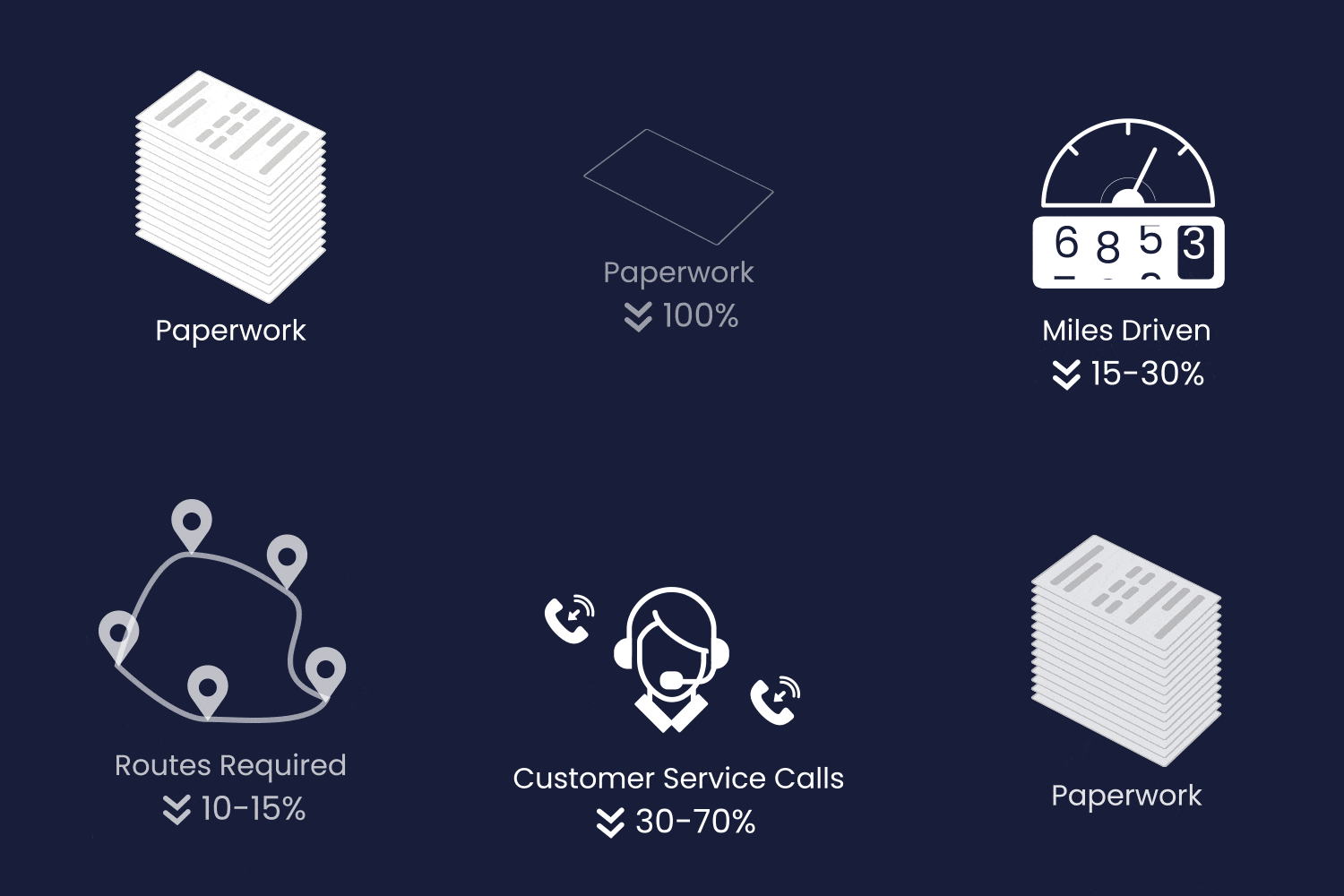
Layer Traditional / Legacy Approach Modern Enterprise AI Stack Key Business Impact 1. Demand Forecasting Macro historical averages, static spreadsheets SKU-level ML predictions, real-time POS & external signals Prevents stockouts, optimizes pre-positioning 2. Route Optimization Overnight static sequence planning Real-time dynamic recalculation & multi-constraint logic 15–30% reduction in driven miles & fuel spend 3. Visibility & Alerts Basic GPS dots on a map, reactive “check calls” Predictive ETAs, multi-party control tower & proactive exception alerts Up to 70% reduction in customer support calls 4. Execution & Dispatch Manual dispatcher assignment, paper manifests Agentic AI dispatch (RoboDispatch), automated ePOD & instant settlement Doubles dispatch throughput; 30% faster billing cycles
The four layers of an Enterprise AI Logistics Stack are most valuable when they work together rather than operating as disconnected point solutions.
Traditional TMS platforms
nuVizz brings these capabilities together through a cloud-based Last-Mile TMS
The platform maps closely to the four layers discussed throughout this article:
1. AI Forecasting & Planning → Demand and Capacity Intelligence
2. AI Optimization → Dynamic Route & Resource Optimization
3. AI Visibility → Network Control Tower & Predictive ETAs
4. AI Automation → RoboDispatch, ePOD & Settlement proof of delivery . Delivery data can also support billing and driver or carrier settlement processes.
This connected approach allows enterprises to move from planning and prediction to optimization, visibility, and execution within a unified operational environment.
Struggling to connect logistics planning, transportation, and execution? Explore Enterprise Solutions
At the center of nuVizz’s AI capabilities is AI Vizzard
The platform uses AI and machine learning to analyze transportation and delivery data and support decisions around routing, order planning, and operational efficiency. nuVizz describes its platform as processing more than 50 million business transactions annually and supporting complex delivery networks at enterprise scale.
AI-driven planning can help logistics teams account for factors such as order density, geographic distribution, available transportation resources, and operational constraints. Rather than relying entirely on fixed planning rules, these capabilities allow transportation decisions to adapt to changing network conditions.
Planning a delivery route is only one part of transportation execution. Orders also need to be assigned, dispatched, monitored, and communicated to drivers and delivery partners.
RoboDispatch™
For large delivery networks, automation becomes particularly valuable when thousands of orders need to be coordinated across multiple vehicles, drivers, facilities, and transportation partners.
Enterprise delivery networks rarely consist of a single fleet operating independently. They may include dedicated fleets, contracted carriers, regional 3PLs, cross-dock facilities, LSPs, and other delivery partners.
nuVizz is designed around this network-oriented model, providing visibility and workflow capabilities across multiple transportation participants rather than limiting operations to a single fleet. Its network management capabilities are designed to standardize technology and processes across delivery partners while maintaining network-wide visibility.
This many-to-many approach is particularly relevant for organizations managing complex delivery ecosystems where orders, transportation resources, facilities, and partners interact continuously.
Enterprise logistics platforms must support more than transportation execution. They also need appropriate security, data protection, auditability, and industry-specific compliance capabilities.
nuVizz states that its platform supports requirements relevant to regulated industries, including HIPAA compliance, DSCSA-related pharmaceutical
These capabilities are particularly important in healthcare, pharmaceutical, medical, and other delivery environments where transportation events may need to be documented and traceable throughout the shipment lifecycle.
The value of an enterprise logistics platform ultimately needs to be demonstrated through real-world deployments and measurable operational outcomes.
nuVizz publicly reports that its platform supports Ford Motor Company’s dealer delivery network, helping deliver approximately 90 million parts annually. nuVizz also reports that 96% of parts ordered by 4:00 PM are delivered by 10:00 AM the following morning.
This example illustrates how network-wide visibility
Beyond individual customer outcomes, nuVizz states that its platform supports more than 50 million business transactions annually and is designed for complex delivery networks involving multiple facilities, carriers, drivers, and customers.
These capabilities position the platform as an integrated foundation for organizations looking to connect AI-driven planning, transportation optimization, real-time visibility
The broader value of the Enterprise AI Logistics Stack is therefore not simply the adoption of AI in one part of transportation. It is the ability to connect forecasting, optimization, visibility, and automation into one continuous operational cycle.
AI is transforming enterprise logistics from reactive operations into more predictive, connected, and automated networks. Organizations can begin by digitalizing core workflows, then progress toward dynamic optimization, real-time visibility, predictive exception management, and automated execution.
The goal is to connect these capabilities into one continuous cycle:
Forecast
→
Optimize
→
Monitor
→
Act
For enterprises managing complex delivery networks, a purpose-built delivery orchestration platform such as nuVizz can help connect these capabilities across fleets, carriers, facilities, and delivery partners—supporting more responsive operations and scalable delivery execution.
Schedule A Demo Contact Us